















-
Related Topics
-
Author:
-
Read time:4 min
Team
Kate Cross
Health Writer at Jean Hailes for Women's Health
Health information for Aboriginal and Torres Strait Islander women.
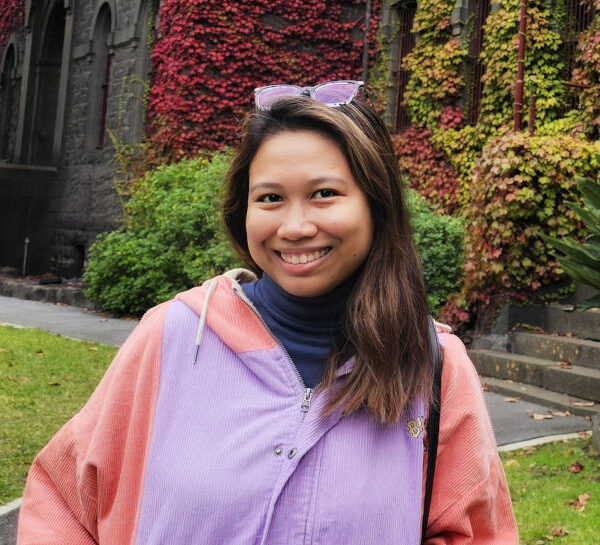
Annie Louey has a habit of turning personal hardships into belly laughs. At this year’s Melbourne International Comedy Festival, the comedian put women’s health centre stage, revealing what it was like having a fibroid the size of an orange surgically removed from her uterus. Hint: it’s not fun, but it can be funny! This Women’s Health Week, Annie talks to our health writer Kate Cross about delving into topics that often go unspoken and the healing powers of comedy.
At 16, Annie Louey walked onto a stage with a bandage on her face and made a room full of strangers laugh. She didn’t talk about her face. She talked about her family, her friends and the silly things that happened at school. For 5 minutes, Annie got to decide what the conversation was about.
The act was part of Class Clowns, a Melbourne International Comedy Festival competition for young people. And the bandage was for serious burns Annie had suffered when she’d fainted into a campfire earlier that year.
You’d think that performing to a crowd would be terrifying, but for Annie, being in control of her narrative felt empowering.
“I’d go outside and people would ask me what happened to my face and it was so intrusive and invasive,” recalls the now 33-year-old. “By going on stage, I didn’t address having burns at all … I just got to forget my problems.”
Using laughter as therapy wasn’t new for Annie. “I think my brain was often wired into saying something funny rather than serious to lighten the mood.” But making it to the national finals of Class Clowns opened up a new world. “It became like, wow … How can I do this more?”
Throughout Annie’s late teens and university days, she did a number of open mic nights to see if she could turn comedy from a hobby into a career. “I performed to one person one night. But that was the humble beginnings of ‘if you really want it, you just got to keep rocking up’. And that’s what I did.”
Since becoming a professional comedian, Annie’s been open about her upbringing and processing difficult things with humour.
Born in Australia to Chinese parents, Annie has needed time to make sense of her identity. “I grew up in an area that didn’t have many Asians, so I wasn’t really in touch with my culture,” she says.
Annie thought that not talking about the past and personal worries was what all families did. (In 2023, she told Australian Story what it was like discovering her late father had a secret family.)
“It wasn’t until I grew older that I could see that [not talking about difficult topics is] definitely a cultural thing – but [it’s] not just limited to Asian culture. Lots of other cultures do the same.”
With time, Annie has learnt to open up. “The more you talk, the more you can change how you perceive that topic. Even something traumatic can be turned into something quite empowering.”
Annie can pinpoint the exact moment she realised her fibroid would make great material for a comedy show.
It “was when they made me use a catheter for a week in hospital”, she says. “That means you have to carry around your own bag of urine. And I have videos and a photo of me going on my daily hospital corridor shuffle with that in hand. And I thought, you know, this is a show. I can see it at the end being in a montage.”
The photo did make it into Annie’s 2026 Comedy Festival show, ‘Putting the Us in Uterus’, which she presented with musician and friend Miranda Hill. But jokes aside, having the fibroid in her uterus was far from fun. It was “a scary time”, she says. “It really affects everything that you do.”
Annie’s fibroid was discovered and surgically removed in 2024. “By October [when I had the surgery], I was hating life. I could not wait to have that surgery,” she says recalling the heavy bleeding, constant weeing and overwhelming tiredness.
Although Annie says the experience was deeply personal, she was reluctant to keep it hidden. “Fibroids affect so many people,” she says. “I wanted to talk openly about it because it shouldn’t be kept so private.”
Talking, says Annie, can help others too. “I share so much on stage … [and] people do send the most personal messages … I think without me offering that first little nugget, I wouldn’t get that in return.
“In sharing my stories, I hope that other people feel more comfortable talking to their circle.”