For the most up to date information on this topic, please visit jeanhailes.org.au
Overview
Experiencing pain instead of pleasure during sex is more common than you may think. Yet many of us struggle to talk about it with our doctors, who may be able to help.
The silence may come from a sense of stigma or shame, a belief that somehow we’re ‘failing’ in the bedroom. But really, none of us needs to suffer in silence.
Here, two doctors who work in the area talk about how to raise the issue with your health professional and get the most from your consultation.
This page is part of our women’s health series, offering simple, practical tips to help you make the most of your medical appointments. This includes advice for:
Experiencing pain instead of pleasure during sex is more common than you may think. Yet many of us struggle to talk about it with our doctors, who may be able to help.
The silence may come from a sense of stigma or shame, a belief that somehow we’re ‘failing’ in the bedroom. But really, none of us needs to suffer in silence.
Here, two doctors who work in the area talk about how to raise the issue with your health professional and get the most from your consultation.
This page is part of our women’s health series, offering simple, practical tips to help you make the most of your medical appointments. This includes advice for:
Dr Margaret Redelman OAM, a GP and sex therapist says that if you’re feeling embarrassed, the best way to raise the issue is to first own it. “Try saying, ‘I’m really embarrassed to be talking about this, but this is what’s happening to me. Are you able to help me?’”
The direct approach is also supported by Dr Karina Severin, a Jean Hailes GP with a special interest in sexual health. “Be open about it,” she suggests. “A useful way to bring it up might be, ‘I’m having some trouble with sex.’
“Even if you feel awkward about bringing it up, the doctor will help you with the conversation.”
Awkwardness is a feeling which, while uncomfortable, will not harm you, adds Dr Margaret.
When discussing painful sex, knowing some of the medical words and the correct names for body parts can help you and your doctor get on the same page. This list may help:
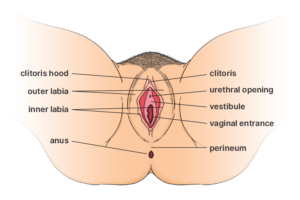
Vulva – Your vulva is the external part of the female genitals that you can see. Learn the different parts of the vulva in the illustration below.
Vagina – Your vagina is inside your body. It extends from your vulva to the start of your uterus.
Dyspareunia – The medical term for ‘painful sex’.
Vaginismus – A health condition where your pelvic floor muscles involuntarily tighten.
Vaginal atrophy – The thinning of your vaginal lining and vulval skin, caused by a drop in oestrogen levels around the time of menopause.
Diagram showing the different parts of the vulva
Painful sex can affect relationships, sometimes even strain them. Dr Severin likes both partners to be involved early in treatment.
“If one person is experiencing pain or discomfort, they can withdraw, and the other partner thinks they’re the problem, or that there’s an issue with the relationship. It’s important for that person to understand what is really going on.”
To aid the process of involving your partner and inviting them to your appointment, Dr Margaret suggests a conversation opener such as:
I love you and want to have a great sex life with you, but I get sore when we have intercourse, and that makes me want to avoid it.
Would you be open to helping me have pain-free sex by coming to my doctor with me?
She explains that a partner can’t help if they don’t know you have a problem or don’t understand what is happening.
“In a relationship, each person is 50% of the sexual relationship. Therefore, both need to be on the same page for the best progress. Learning together to achieve your best sex life can be a very intimate experience,” she adds.
Talking about midlife brain fog
Talking about brain fog can be tricky. It’s a symptom that often comes and goes, and can be hard to describe. But Jean Hailes GP Dr Tessa King says that providing details and examples of your experience is crucial.
“If you’re not performing as well at work, or if you’re having difficulty in juggling the schedule of everyone at home, tell the doctor.”
“You can say things like, ‘it feels like a physical fog around me’, or ‘my brain is not working with the same clarity as before’.
“Even using the word ‘brain fog’ can be helpful. The doctor will be trying to make sense of the symptoms, so the more detail you can provide, the better.”
Associate Professor Caroline Gurvich, deputy director of HER (Health, Education, Research) Centre Australia, agrees. “Tell the doctor exactly what is happening:
if you have difficulty remembering names
if you feel you can’t make decisions as efficiently as you used to
and if you can’t find the right words to describe what is happening, use the term ‘brain fog’.”
We speak to three women about the realities of living with pain, and share insights and advice from the experts.
Read now
When to visit a doctor about pain during sex
First things first, it’s important to take action and to make an appointment. One of the factors stopping women from seeking treatment is that they worry that the issue is trivial, says Dr Margaret.
“We need to empower these women and help them understand that their pain is as valid as any pain,” she explains. “Each person’s experience is as valid as the next.”
“The myth out there is that sex is natural. What’s true is that the instinct is natural, but the performance is a learnt experience.”
When it comes to tricky topics, it can be helpful to know what sorts of questions your doctor will ask you. You can then think about your answers beforehand and feel more confident and prepared.
For painful sex, your doctor will likely ask:
When did the pain start? When does it occur? And what does it feel like?
What makes it better and what makes it worse?
Does it hurt when you’re touched on the outside?
Is it ‘entry pain’ when penetration starts or is attempted? Is it ‘deep pain’ that usually happens with deep penetration or thrusting?
Do you have pain after sex?
Do you have pain or a burning sensation when passing urine after sex?
You may also be asked questions about:
your sexual history
your sexually transmitted infections
sexual positions that might cause you discomfort
whether you have ever experienced sexual trauma.
“What the doctor is trying to do is establish if the pain is a medical problem, a psychological problem or a relationship problem,” explains Dr Margaret.
Your doctor may also examine you.
This may involve gently touching the vulva and an internal examination to establish the site of the pain.
The doctor may also place a speculum – the instrument used during cervical screening – inside the vagina to locate the source of the pain.
If you’re uncomfortable at any point, you can ask the doctor to stop.
For women who raise the issue with their doctor but don’t feel heard, Dr Margaret has one final piece of advice: “If you feel the doctor has not understood you, dismissed you or hasn’t provided helpful management, you have some options.
Ask the health professional if this is an area of interest for them and, if not, ask for a recommendation to see someone else.
Try to explain what you are experiencing again. If you still feel dismissed, ask friends for a recommendation to another GP.
“As an adult, it is your duty to yourself to look after your needs and health, and you are worthy of this.”
Easy Read fact sheets are about what happens when you go to the doctor, including tips on what you can do before, during and after your appointment.
Review process
Our review process
This information has been reviewed by clinical experts and is based on the latest evidence.
Our content review process ensures our health information is accurate, trustworthy, current and useful.
We regularly check our information to make sure it reflects the latest clinical guidelines and key findings from large, reliable studies.
Where possible, we focus on Australian research to make our information more relevant locally.
Experts play a key role in reviewing our content. Clinicians at Jean Hailes check information for accuracy and real‑world relevance. These include GPs, gynaecologists, endocrinologists, psychologists and allied health professionals.
We also work with partner organisations, independent specialists and people with lived experience to make sure our content reflects both expert knowledge and the experiences of the community.
Absent periods • Heavy periods (menorrhagia) • How to use tampons and menstrual cups for the first time • Irregular periods • Period pain • Period products • Premenstrual dysphoric disorder (PMDD) • Premenstrual syndrome (PMS)
Abortion • Contraception • Enjoying your sex life • Healthy relationships • Painful sex (dyspareunia) • Safer sex and sexually transmitted infections (STIs) • Testosterone therapy • What can affect your sex life?
How to manage menopausal symptoms • How to use gel – menopausal hormone therapy • How to use patches – menopausal hormone therapy • How to use vaginal estrogen cream – menopausal hormone therapy • How to use vaginal pessaries – menopausal hormone therapy • Looking after yourself around the time of menopause • Medically induced menopause • Menopausal symptom treatments • Menopause information for partners • Premature and early menopause